Welcome to the Bitcoin Price Time Machine. Please keep your hands inside the vehicle. Our first stop is December 7, 2010, when one bitcoin cost twenty-four cents, roughly the price of a gumball. Hold on to that number. By the end of this tour it will have become $82,315, and every critic you are about to meet will have been standing on the wrong side of it.
Thesis: These nine archived quotes capture criticism of Bitcoin at an average price of $24—3,469x lower than today’s $82,315.
Think of this as a museum with nine exhibits and six critics. Each one comes with a receipt: the exact words, the date, and the price of a bitcoin on the day they were said. The tour runs from December 7, 2010 to April 11, 2013. Admission was never cheaper.
What did critics say when Bitcoin was under $100?
Before the guided tour, the floor plan. Here is every exhibit on one wall. Change to today is today’s $82,315 divided by the recorded price, approximately.
| Date | Quote (linked) | Critic | BTC then | Change to today |
|---|---|---|---|---|
| 2010-12-07 | Currency objection | The Underground Economist | $0.24 | 342,979x |
| 2011-05-07 | Failure analogy | Avery Pennarun | $3.50 | 23,519x |
| 2011-05-07 | Failure prediction | Avery Pennarun | $3.50 | 23,519x |
| 2011-05-07 | Mining objection | Avery Pennarun | $3.50 | 23,519x |
| 2011-05-07 | Power and Bitcoin’s appeal | Avery Pennarun | $3.50 | 23,519x |
| 2011-06-06 | Speculative-value comparison | Tav | $15.00 | 5,488x |
| 2011-06-19 | Security and liquidity objections | Tim Worstall | $17.50 | 4,704x |
| 2013-04-11 | Burst-bubble headline | Robert Nielsen | $83.40 | 987x |
| 2013-04-11 | Resource-use objection | Paul Krugman | $83.40 | 987x |
Now, the tour.
Who called Bitcoin worthless when it cost $0.24?
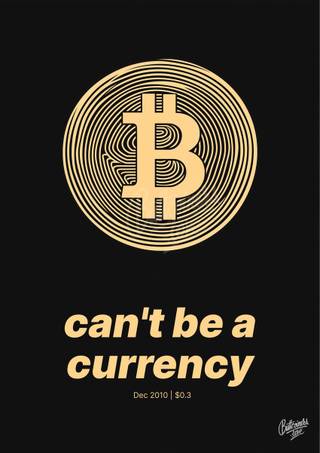
Exhibit A sits in the oldest room of the museum. It is late 2010. Bitcoin is a forum curiosity worth less than a quarter. Into this quiet room walks The Underground Economist, a personal blogger with a headline that leaves no room for a sequel:
Why Bitcoin can’t be a currency
The original post now survives only through the Wayback Machine. The asset it dismissed survives rather better: anyone who bought one bitcoin instead of reading the post would today hold 342,979 times their twenty-four cents.
Why did Avery Pennarun say Bitcoin would fail at $3.50?
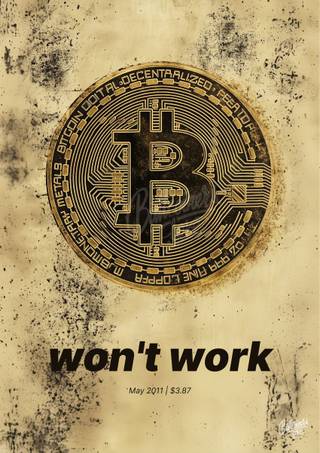
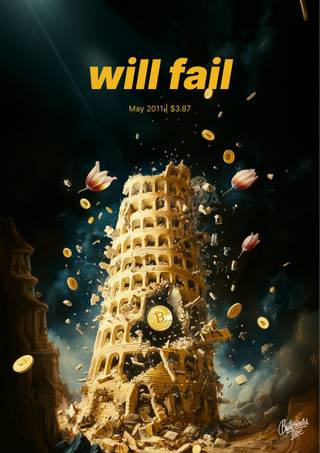
Five months later, the price had risen fourteen-fold, and the confidence of the critics somehow rose with it. May 7, 2011. Bitcoin at $3.50. Our next guest is Avery Pennarun, today the CEO of Tailscale, writing his first Bitcoin post on Apenwarr. The museum keeps four lines from that single post, so this room has four exhibits. One author, one afternoon, zero hedging.
Exhibit B opens with an analogy, delivered with the calm of a man who has looked at the sky:
Asking why I think bitcoin won't work is like asking why the sky isn't red.
Exhibit C is the headline itself, the kind that would later be printed, framed and hung in rooms like this one:
Why bitcoin will fail
Exhibit D turns to mining, the process that secures the Bitcoin network. The verdict at the time:
Mining (they even borrowed the word!) bitcoins is pointless busywork that produces nothing of real value.
And then Exhibit E, the plot twist hidden in the same post. In the middle of explaining why it would fail, Pennarun put his finger on exactly why people wanted it:
One of the lures of bitcoin is the idea of taking power away from the people in power.
To be fair to our guest, that line describes an attraction of Bitcoin, not a failure prediction. It is the one exhibit in this room that aged well. Every one of the four was written at $3.50; a bitcoin now costs 23,519 times what it did that afternoon.
Was Bitcoin compared to stamps and comic books in 2011?
We move into the summer of 2011. The price has climbed to $15, and critics have started reaching for comparisons. On June 6, Tav, a software developer, wrote a personal blog post that placed Bitcoin on the collectibles shelf. Exhibit F:
Bitcoin is not a viable currency. It is a store of speculative value — much like investing in stamps, comic books and vintage shoes.
Here the museum adds a footnote: the archive also flags Tav as a critic who later turned buyer. The stamp collection, it seems, got a new member.
Thirteen days later, the tour leaves the blogs for a bigger stage. June 19, 2011, Bitcoin at $17.50, and Tim Worstall makes the case in Forbes. Exhibit G is a single sentence that manages to dismiss nearly every job money is supposed to do:
Bitcoins aren't secure, as both the recent theft and this password problem show. They're not liquid, nor a store of value, as the price collapse shows and if they're none of those things then they'll not be a great medium of exchange either as who would want to accept them?
Who would want to accept them? At $17.50, a fair question. At 4,704 times that price, the question answers itself.
Who declared the Bitcoin bubble over at $83.40?
The last room of the tour. Two years pass. It is April 11, 2013, Bitcoin trades in the $80s, and the word of the day is "bubble". Two critics enter on the same day, at the same price.
First, economist Robert Nielsen, writing on Whistling In The Wind. Exhibit H is an obituary, delivered with the confidence of a coroner:
The Bitcoin Bubble Has Burst
The article has since been taken down. The archive kept it anyway; that is what archives are for.
Then the most famous name on the tour. Paul Krugman, Nobel laureate in economics, arrives with an 18th-century economist for backup. Exhibit I:
People think it's smart, nay cutting-edge, to create a sort of virtual currency whose creation requires wasting real resources in a way Adam Smith considered foolish and outmoded in 1776
Both exhibits were written at $83.40. Both now sit 987 times below today's price, the smallest gap on the tour and still nearly a thousand-fold.
What does Bitcoin’s $82,315 price say about these predictions?
Our take: The tour began at twenty-four cents. The failure headline arrived at $3.50. The burst-bubble headline arrived at $83.40. Bitcoin now costs $82,315. A price does not settle every argument about currency, security or resource use—but it makes those sweeping verdicts look decidedly premature. Nine exhibits, six critics, one direction of travel. That is why the dates and decimals stay attached. The predictions had certainty. We kept the receipts.
Thank you for visiting the Bitcoin Price Time Machine. The next stop on the tour is under $1,000, where the exhibits get louder and the receipts get longer.
Frame the receipts
Every bad take here comes framed. Tap one to see the full record and collect it.